-
 Pick up from the GEA Store
-
 Courier delivery
-
 DHL Courier delivery


 Pick up from the GEA Store
Courier delivery
DHL Courier delivery
Pick up from the GEA Store
Courier delivery
DHL Courier delivery
 Warranty 1 year

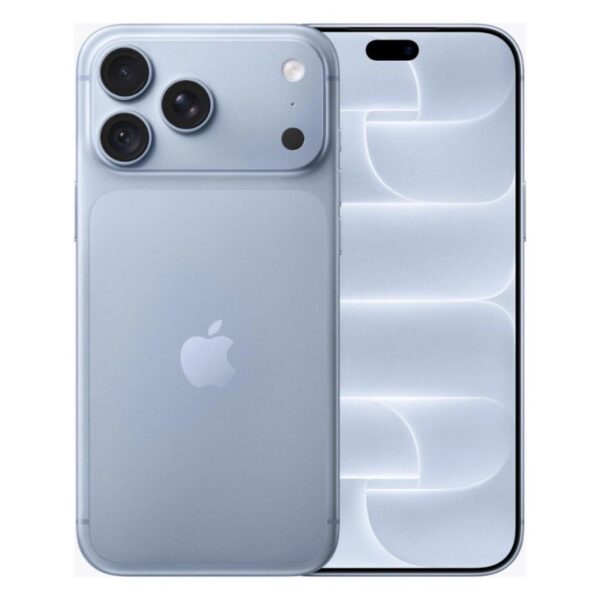
Apple unveiled the iPhone 18 Pro on September 9, 2026, and it’s less a redesign than a deep refinement of the aluminum-bodied iPhone 17 Pro that came before it. The headline change is variable aperture — a first for iPhone — paired with Apple’s new A20 Pro chip, a redesigned vapor chamber, and the longest battery life a non-Max iPhone has ever offered. If you found the iPhone 17 Pro’s shape and size right but wanted more creative control over your photos, longer battery life, and noticeably snappier performance under sustained load, the iPhone 18 Pro is built specifically for you.
It keeps the 6.3-inch Super Retina XDR display, the aluminum unibody frame, and the extended camera plateau that defined last year’s redesign, so this isn’t a phone that looks dramatically different in your hand. What changed is almost everything underneath: a new 2-nanometer chip, a camera sensor that can physically open and close its aperture, and a cooling system with three times the surface area of its predecessor.
Burgundy

The iPhone 18 Pro carries over the aluminum unibody frame that the iPhone 17 Pro introduced last year, along with Ceramic Shield 2 on the front and Ceramic Shield on the back. It measures 150.0mm tall, 71.9mm wide, and 8.75mm thick, weighing 211 grams — essentially identical to its predecessor. What’s new is the color lineup: Black, Silver, Glacier, and a dark red Burgundy that replaces last year’s Cosmic Orange as the standout shade. The frame is now color-matched to the back glass for a more unified look than previous generations.
For the first time since it debuted on the iPhone 14 Pro, the Dynamic Island shrinks. Apple used more advanced display technology to reclaim screen space while keeping the Face ID hardware hidden underneath it. The trade-off is a functionality gain, not a loss: the redesigned Dynamic Island can now surface three Live Activities at once instead of two, so more of what you’re tracking — a delivery, a timer, a score — stays visible without opening the app.
The iPhone 18 Pro carries an IP68 rating, tested to withstand submersion up to 6 meters for 30 minutes under IEC standard 60529. Combined with the Ceramic Shield front and back, it’s built to shrug off the daily wear of pockets, bags, and the occasional splash or drop, without asking you to baby it.
The iPhone 18 Pro keeps its 6.3-inch Super Retina XDR OLED panel, running at 2622 by 1206 pixels and 460ppi, with ProMotion’s adaptive refresh rate scaling up to 120Hz depending on what’s on screen. Peak outdoor brightness stays at 3,000 nits with a 2,000,000:1 contrast ratio, and the panel keeps its Always-On display, True Tone, wide color (P3), and anti-reflective and fingerprint-resistant coatings from the previous generation.
The one meaningful change lives at the top of the screen: Apple engineered a smaller TrueDepth camera module, which is what makes the shrunken Dynamic Island possible without sacrificing Face ID. Everything else about the viewing experience — HDR support, color accuracy, brightness in daylight — carries over largely unchanged from the iPhone 17 Pro, which itself was already one of the best OLED panels on any phone.
The biggest change to the iPhone 18 Pro is physical, not computational: the 48MP Fusion Main camera now has a variable aperture, controlled by six laser-cut blades that smoothly open and close between four settings — ƒ/1.48, ƒ/1.8, ƒ/2.8, and ƒ/4.0. It’s the first time an iPhone camera has been able to physically adjust how much light hits the sensor, rather than relying entirely on software processing after the fact.
In practice, the camera picks the right aperture automatically for the scene: widening to ƒ/1.48 in low light to pull in more detail, or narrowing to ƒ/4.0 in a group shot so more of the background stays in focus rather than blurring away. Portraits default to ƒ/1.8, which Apple tuned as the sweet spot between light gathering and depth of field. For anyone who wants to take over manually, every aperture setting is adjustable in the Camera app, and Apple has opened an API so third-party camera apps can access the same range of control.
The rest of the rear array carries over the triple 48MP Pro Fusion system from the iPhone 17 Pro: a 48MP Fusion Ultra Wide at ƒ/2.2 with a 120-degree field of view, and a 48MP Fusion Telephoto with a tetraprism design giving 4x optical reach (100mm) and a 12MP optical-quality 8x mode (200mm). Combined with the Main camera’s own 2x optical-quality crop, the system spans a 16x optical-quality zoom range, with digital zoom reaching up to 40x.
Alongside variable aperture, Apple added Pro controls — a customizable panel in the Camera app for adjusting aperture, shutter speed, and white balance manually, plus a live histogram for checking exposure as you shoot. Photographic Styles gains new texture and grain controls, letting you dial in a personal look across color and skin tone together rather than as separate sliders. On the video side, Cinematic mode effects can now be applied after you’ve already shot the footage (up to 60fps), Time-lapse supports full 4K in Dolby Vision HDR, and Audio Mix has been upgraded to isolate music from voices with noticeably better clarity.
One genuinely new feature is Apple Reference Image: a new sensor in the Main camera signs every pixel it captures, and when you shoot in Reference mode, Apple’s Private Cloud Compute builds an unalterable reference copy of the photo. You can pull that reference image up in the Photos app next to your edited version — like a digital negative — to visually confirm what was and wasn’t changed. It’s aimed squarely at photojournalists and anyone who needs to prove a photo hasn’t been manipulated, though it’s opt-in and, at least at launch, unavailable in China and limited to viewing (not capture) in the EU.
Up front, the 18MP Center Stage camera is unchanged on paper — ƒ/1.9 aperture, autofocus with Focus Pixels, and the square sensor design that lets it switch between portrait and landscape framing for selfies without you having to rotate the phone. It sits behind the smaller Dynamic Island module now, but functions identically to the iPhone 17 Pro’s front camera.
Powering the iPhone 18 Pro is the A20 Pro, Apple’s first chip built on a 2-nanometer manufacturing process — a jump from the 3nm A19 Pro in last year’s model. It pairs a 6-core CPU (2 performance cores, 4 efficiency cores) with a new 7-core GPU that Apple says is up to 40 percent faster than the A19 Pro’s, plus a Dual 16-core Neural Engine that doubles the AI processing headroom of the previous generation. Memory bandwidth is up 50 percent, and the CPU’s integrated Neural Accelerators are built to speed up on-device AI workloads specifically, rather than general compute alone.
The less obvious but arguably more meaningful upgrade is thermal. Apple redesigned the chip’s packaging so the silicon die sits side by side with memory instead of stacked on top of it, pulling memory out of the chip’s thermal path entirely. That lets A20 Pro connect directly to a next-generation vapor chamber with roughly three times the surface area of the one in the iPhone 17 Pro. The result, according to Apple, is up to a 40 percent gain in sustained performance — the kind of improvement you notice less in a quick benchmark and more during a long gaming session, an extended 4K video export, or back-to-back demanding camera captures, where phones without better cooling typically slow down to manage heat.
Both models also introduce N1, Apple’s own wireless networking chip, handling Wi-Fi 7, Bluetooth 6, and Thread in a single package. On the cellular side, the iPhone 18 Pro moves to Apple’s second-generation in-house modem, C2, which the company says delivers meaningfully faster uploads than the previous C1X while using 15 percent less power, and adds mmWave 5G support in the U.S. for the first time on Apple silicon.
Battery life sees one of the bigger year-over-year jumps in iPhone history. eSIM-only iPhone 18 Pro units are rated for up to 36 hours of video playback, up from 33 hours on the iPhone 17 Pro, with typical everyday use rated at up to 24 hours. Apple credits the gain to a combination of the A20 Pro’s power efficiency and a new battery design that takes advantage of the internal space freed up by dropping the physical SIM tray entirely — iPhone 18 Pro is eSIM-only in supported markets, and that reclaimed space goes straight into extra battery capacity.
Charging is faster too: the iPhone 18 Pro can reach 50 percent charge in around 15 minutes using a 60W-capable USB-C adapter with Adjustable Voltage Supply, or hit the same 50 percent mark in 30 minutes over MagSafe or Qi2 wireless charging, both now supporting up to 25W. For anyone who regularly tops up in short bursts between meetings or during a commute, that’s a meaningful improvement over topping up more slowly with older adapters.

The iPhone 18 Pro ships with iOS 27 and the next generation of Apple Intelligence, alongside Siri AI — a rebuilt version of Siri that Apple describes as far more personal, capable, and conversational than what came before. Siri AI can draw on context across your messages, emails, and photos to help you find things faster, use onscreen awareness to act on whatever’s currently on your display, and answer open-ended questions the way a general-purpose assistant would. A new Siri mode inside the Camera app lets you point your phone at something and ask about it directly, and you can dictate what you want written rather than typing it yourself.
Apple Intelligence also extends into the built-in apps: Spatial Reframing and Extend let you adjust a photo’s composition after it’s already been taken, Clean Up has been upgraded for more convincing object removal, and Image Playground now generates photorealistic images rather than the more stylized output of earlier versions. In Safari, a new Notify Me feature watches web pages for changes — useful for tracking restocks or price drops — and alerts you when something shifts.
Most of this processes on-device where possible, with Private Cloud Compute handling anything that needs more horsepower while extending the same privacy protections you get locally on the phone into the cloud. Siri AI itself is rolling out as a beta at launch, initially in English only, with French, Japanese, Korean, Portuguese, and Spanish support following in October — and it won’t be available in the EU on iOS at launch due to ongoing regulatory discussions. iOS 27 separately brings iPhone Handoff, letting you switch between two iPhones on the same number (starting with T-Mobile in the U.S. and Telekom in Germany), along with expanded parental controls and further refinements to the Liquid Glass interface introduced last year.
iPhone 18 Pro uses eSIM exclusively in markets where Apple sells the eSIM-only variant, including the U.S., Canada, Japan, Mexico, Saudi Arabia, the UAE, and several others — meaning no physical SIM tray at all. eSIM is supported by more than 500 carriers worldwide, including AT&T, T-Mobile, and Verizon, and the phone supports two active eSIMs at once with room to store eight or more. Beyond the battery-life benefit of freeing up internal space, eSIM also makes switching carriers or adding a travel plan possible entirely from the Settings app, without hunting for a SIM tool.
On the networking side, the phone supports 5G with mmWave in the U.S., Wi-Fi 7, Bluetooth 6, Thread, Ultra Wideband (second-generation), and NFC with reader mode for Apple Pay and Express Cards. Apple’s satellite features — Emergency SOS, Messages, Find My, Crash Detection, and Roadside Assistance — all carry over from the previous generation for staying connected outside of cellular and Wi-Fi coverage.
| Component | Specification |
|---|---|
| Body | 150.0 x 71.9 x 8.75mm, 211g, aluminum unibody, Ceramic Shield 2 front & Ceramic Shield back, IP68 rated |
| Display | 6.3″ Super Retina XDR OLED, 2622 x 1206px, 460ppi, ProMotion up to 120Hz, 3000 nits peak (outdoor) |
| Chipset | Apple A20 Pro (2nm), 6-core CPU, 7-core GPU, Dual 16-core Neural Engine |
| Memory | 256GB / 512GB / 1TB / 2TB storage, non-expandable |
| Rear Camera | 48MP Fusion Main (variable aperture ƒ/1.48–ƒ/4.0) + 48MP Fusion Ultra Wide ƒ/2.2 + 48MP Fusion Telephoto ƒ/2.8 (4x/8x optical-quality) |
| Front Camera | 18MP Center Stage, ƒ/1.9, square sensor for auto portrait/landscape framing |
| Video | 4K Dolby Vision up to 120fps, ProRes & ProRes RAW, Cinematic mode up to 4K/60fps |
| Battery | Up to 36 hrs video playback (eSIM-only), up to 24 hrs typical use |
| Charging | Up to 50% in ~15 min wired (60W-capable adapter), 50% in 30 min via MagSafe/Qi2 (up to 25W) |
| Connectivity | 5G (sub-6GHz & mmWave), Wi-Fi 7, Bluetooth 6, Thread, UWB 2, NFC, dual eSIM only |
| Software | iOS 27, Apple Intelligence, Siri AI (beta) |
| Colors | Black, Silver, Glacier, Burgundy |
If you already own an iPhone 17 Pro, this is not an urgent upgrade — the shape, screen, and starting price bracket are all familiar, and Apple itself has described this cycle as an internal refinement rather than a redesign. But for anyone shooting seriously on their phone, the jump from a fixed aperture to a physically variable one is a real creative unlock, not a marketing footnote: it changes what’s actually possible in low light and group shots without reaching for a separate camera. Combined with the longer battery life and the cooler-running, more consistently fast A20 Pro, it’s a meaningful step up for photographers, video creators, and anyone coming from an iPhone 15 Pro or older who’s due for a refresh anyway.
For buyers who want the largest possible screen and the biggest battery gain of the two, the iPhone 18 Pro Max remains the step up — but for a Pro iPhone sized to fit comfortably in one hand while still packing the same camera system and chip, the iPhone 18 Pro is Apple’s standard-bearer for 2026.
The design, screen size, and dimensions are nearly identical. The real differences are internal: the new A20 Pro chip on a 2nm process, a variable-aperture main camera (the 17 Pro’s aperture is fixed), a redesigned vapor chamber for better sustained performance, longer battery life, and a smaller Dynamic Island capable of showing three Live Activities instead of two.
It lets the Main camera physically widen or narrow its aperture across four settings — ƒ/1.48, ƒ/1.8, ƒ/2.8, and ƒ/4.0 — instead of relying on a single fixed opening. A wider aperture pulls in more light for low-light shots; a narrower one keeps more of a scene in focus, which is useful for group photos. The camera chooses automatically by default, or you can set it manually in Pro controls.
In markets where Apple sells the eSIM-only version — including the U.S. — no. It uses eSIM exclusively, supporting two active eSIMs at once. This also frees up internal space that Apple uses for extra battery capacity.
Up to 24 hours of typical mixed use, or up to 36 hours of continuous video playback on eSIM-only models. It charges to 50% in around 15 minutes with a 60W-capable wired adapter, or in 30 minutes over MagSafe or Qi2 wireless charging.
Yes, as a beta rolling out with iOS 27, initially in English only. French, Japanese, Korean, Portuguese, and Spanish support are expected in October. Siri AI is not available in the EU on iOS at launch.
Four finishes: Black, Silver, Glacier, and the new Burgundy, which replaces last year’s Cosmic Orange as the standout color option.
The camera system spans a 16x optical-quality zoom range in total — from 2x optical-quality zoom out on the Main camera to an 8x optical-quality Telephoto mode (200mm). Beyond that, digital zoom extends up to 40x, though quality drops the further past the optical range you go.
Yes. It supports both MagSafe and Qi2 wireless charging, each now rated up to 25W — enough to reach 50% charge in about 30 minutes on a compatible charger.
256GB, 512GB, 1TB, and — for the first time on a non-Max iPhone — 2TB. Storage isn’t expandable, so it’s worth picking a tier with headroom for photos and 4K/ProRes video if you shoot a lot.
They share the same chip, camera system, and software. The Pro Max has a larger 6.9-inch display, a bigger body (249g vs 211g), and a bigger battery — up to 45 hours of video playback versus 36 hours on the standard Pro, which Apple says is the largest battery-life jump it has ever delivered on an iPhone.
Apple Intelligence supports English, Chinese (Simplified & Traditional), French, German, Italian, Japanese, Korean, Spanish, Portuguese, and several other languages at launch. Siri AI specifically starts in English only, with French, Japanese, Korean, Portuguese, and Spanish following in October — availability can vary by region.
In stock
 Enquire Now
This product has multiple variants. The options may be chosen on the product page
Enquire Now
This product has multiple variants. The options may be chosen on the product page
In stock
Enquire Now
This product has multiple variants. The options may be chosen on the product page

In stock
Enquire Now
This product has multiple variants. The options may be chosen on the product page
No account yet?
Create an Account